Investor pitch deck makeover: From basic slides to investor-ready
March 11, 2026 | 6 min read

If your pitch deck reads like a document instead of a visual story, this post walks through seven real before and after redesigns and what changed in each one.
Most founders believe investors fund ideas.
In reality, investors fund clarity.
A pitch deck is often the first serious interaction between a startup and potential investors. But the window to make an impression is much smaller than most founders expect.
Research from DocSend, which analyzed thousands of startup pitch decks shared with investors, found that investors spend an average of about 3 minutes and 44 seconds reviewing a pitch deck before deciding whether to move forward.
DocSend later reinforced the same insight in its pitch deck research, showing that investors typically spend only a few minutes reviewing a deck, which means every slide must communicate quickly and clearly.
This limited attention window changes how a pitch deck should be designed.
Slides are not meant to function as documents filled with paragraphs and dense tables. They are visual tools meant to communicate key ideas quickly. Cognitive research shows that humans can recognize images in as little as 13 milliseconds, which explains why well-structured visuals often communicate ideas far more effectively than blocks of text.
In other words, investors are not carefully reading every line of your pitch deck.
They are scanning.
They are looking for signals of clarity, structure, and credibility.
When slides are crowded or poorly organized, investors must work harder to understand the opportunity. When slides are designed with clear hierarchy and visual structure, the same information becomes easier to absorb and evaluate.
Good pitch deck design is not about decoration.
It is about reducing friction between insight and understanding.
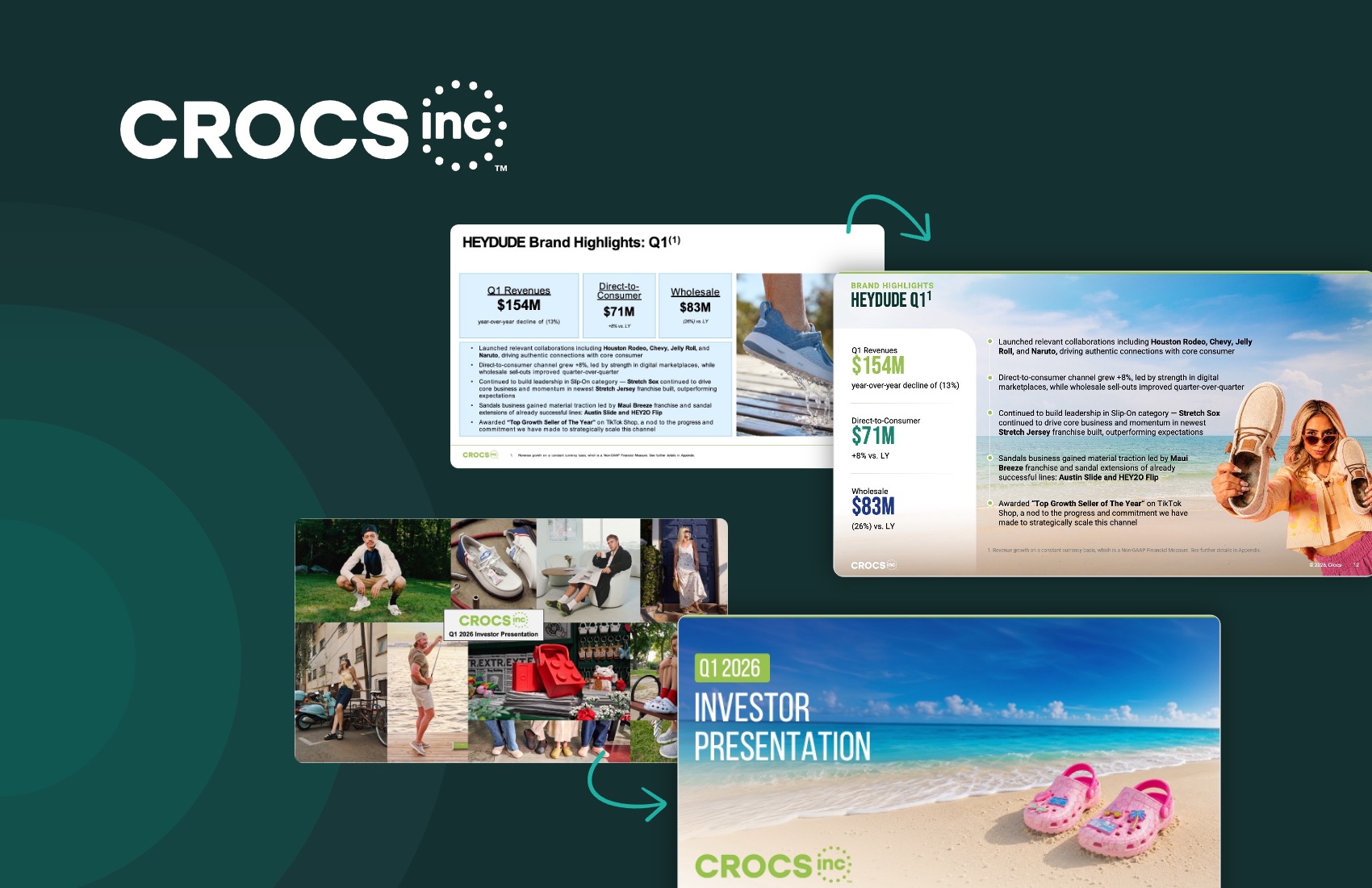
The before-and-after slides below show how the same investor pitch deck can become clearer, more structured, and easier to understand when design is used to guide the story.
1. The opening slide: turning a title into a first impression
The opening slide of a pitch deck sets the tone for everything that follows.
In many early versions of investor decks, the first slide simply presents a title on a blank background. It technically communicates the topic, but it does not establish context, emotion, or credibility.
A redesigned opening slide changes that dynamic immediately.
Strong imagery, balanced composition, and thoughtful typography transform the same idea into a visual statement. The slide begins to communicate the brand, the market, and the ambition behind the company before the presenter even speaks.
Instead of feeling like a draft document, the pitch begins to feel like a business ready to scale.


2. Explaining the company clearly
One of the earliest slides in a pitch deck usually explains what the company does and why it exists.
In many founder decks, this information appears as a paragraph followed by scattered metrics. While the information may be useful, the structure forces investors to search for the key message.
A well-designed slide reorganizes the same information into clear visual hierarchy.
Metrics become focal points instead of footnotes.
The narrative becomes easier to scan.
The relationship between numbers and message becomes obvious.
The goal is not decoration. It is clarity.
Investors should understand the scale and ambition of the business within seconds of seeing the slide.


3. Presenting the market opportunity
Market opportunity is one of the most important sections of any investor deck.
Yet it is often presented as blocks of text or disconnected bullet points. The audience receives the information, but the strategic insight gets buried.
A stronger approach organizes the opportunity into structured ideas.
Instead of asking investors to interpret the information themselves, the slide guides them through the narrative. Each element reinforces the argument that the market exists, the demand is real, and the timing is right.
When this structure is supported by visual hierarchy and spacing, the slide becomes easier to absorb and far more persuasive.


4. Turning data into a story
Great investor decks do more than present facts. They humanize the market.
Many early decks introduce customer insights using long explanations or scattered notes. While the insight may be valuable, it often lacks emotional connection.
A redesigned slide introduces the same concept through narrative.
By structuring the information around a clear character and supporting visuals, the audience understands the behavior, motivations, and opportunity within the market.
This approach transforms abstract market analysis into a relatable story, which makes the opportunity feel tangible.


5. Making the business model easy to understand
When investors evaluate a business, they want to understand how the company actually makes money.
Many decks explain the model through dense tables or operational details that are difficult to process quickly.
A clearer slide breaks the structure into digestible sections.
Information is grouped logically.
Key components of the model become easier to compare.
The structure of the business becomes visible at a glance.
Instead of decoding the slide, investors can immediately focus on evaluating the opportunity.


6. Presenting the product portfolio
Product or service offerings are another area where decks often become cluttered.
Founders frequently list categories, features, and product types in long bullet lists. While this may document the offering, it does little to create clarity.
A redesigned slide organizes the portfolio visually.
Products are grouped into categories.
Spacing separates ideas.
Visual elements reinforce the positioning of the brand.
This approach helps investors understand both the breadth and the focus of the product strategy.


7. Showing differentiation clearly
The final sections of a pitch deck often explain why the company is different from competitors.
In early decks, this usually appears as a comparison table filled with text. The content may be accurate, but the structure makes it difficult to interpret quickly.
A stronger slide highlights differentiation through visual emphasis and structured layout.
Instead of reading every line, investors can immediately identify the strategic advantages of the business.
The slide becomes a summary of positioning rather than a wall of information.


The conclusion: Design does not replace strategy. It reveals it.
A well-designed investor deck does not invent new ideas. It simply makes the existing ideas easier to understand.
When information is structured clearly:
Investors process the opportunity faster.
The narrative becomes more persuasive.
The business appears more credible.
In high-stakes settings like fundraising, clarity can make the difference between interest and indifference.
Your slides are not just visual aids.
They are the medium through which your strategy travels.

We use storytelling and design to build high impact presentations for leading brands
PowerPoint design
services and outsourcing
Enterprises, analysts, consultants
Investor pitches
and fundraising narrative
Founders, fund managers
Sales presentations, proposals, and collaterals
Sales & marketing teams
PowerPoint template and visual slide bank
Enterprises, advisory & research firms
CXO presentations
and thought leadership
IT-BPO services & consulting firms
Financial, ESG,
and annual reports
Financial services, large enterprises
Training – PowerPoint design and visualization
Sales team, analysts, consultants
Conference and event presentations
Keynote speakers, event managers